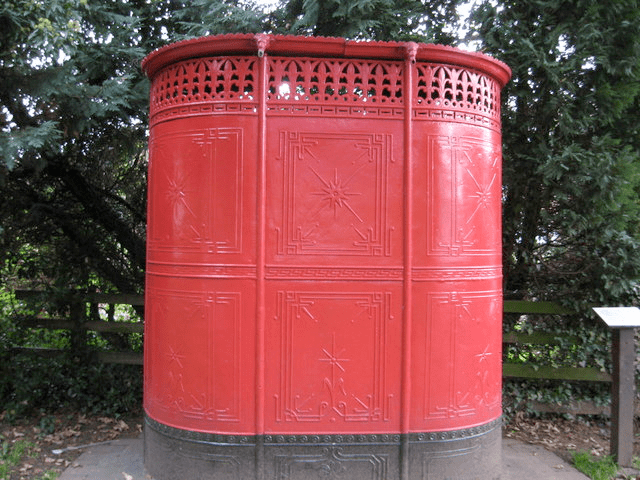
If you have lived in or visited London, you may have seen old public urinals. These stand-alone structures weren’t usually located next to proper toilets, because the men need to pee far more often than defecate. Women weren’t even considered. Women were expected to stay home most of the day, and to time their bodily functions with the lack of facilities in mind, while men were in public (often working) most of the day and needed places to relieve themselves. Thus public urinals were built. Men could exist in the public sphere, while women were to stay hidden away at home save for the short shopping trip.
This was the urinary leash. If you were a woman, you couldn’t go further than you could hold it.
Content Note
Trans folk might want to steer clear of this post. You know all this already. I talk about violence, discrimination, sui, hate, bathrooms, locker rooms, genitals, surgery, and similarly heavy topics below. I believe that serves a purpose for a non-trans audience, particularly those with what they feel are legitimate concerns, but I’m not sure it’s something trans folks need to read. We live this daily already. I also draw an analogy to racism, in a way I hope is not offensive to Black people.
Toilets are Political
When the first public toilets for women were opened in Victorian London, they were vandalized by men. Later, after WWII, in the UK, US, and elsewhere, lack of women’s facilities was justification for factories refusing to hire women–the very women who worked at those factories during the war. They didn’t have the facilities, you see, and of course not only would they need considerable space and expense to fit out, but you need more space for women (something that has its’ roots in the impractical women’s clothing of Victorian times, where you basically needed to significantly undress just to use the toilet). In post-WWII it wasn’t the garments women wore, but that women were told they were delicate and needed additional space to rest. It was for their own safety, you see. Again, these were the same factories that employed women in the existing spaces during the war. It was an excuse.
Toilets are always political. Today, we have building codes that result in women waiting in long lines while cis men can walk up to a urinal and be done in in under a minute. Women spend significant time just waiting for a toilet, because building codes are rarely designed to be equitable (in contrast to “equal”) and they fail to care that it takes a bit longer for someone sitting to pee.
But it’s not just about gender!
Stroll through any American city and try to find a place to pee that is both legal and doesn’t require you to be a customer. You will be hard pressed to find facilities, and, if you do, they will be disgusting. If public toilets are proposed to solve this, this is often shot down by NIMBY-ism, with justifications talking about the infrastructure needed, vandalism, drug use, public sex, and cost. These excuses often hide another reason: they could be used by homeless people. Just as women in Victorian England had a urinary leash, it’s hard to exist as a homeless person in a given location where you can’t use a toilet, which anti-homeless people know. They see toilets are attracting homeless, as if homelessness disappears just because it’s now illegal to pee (one of the reasons transit elevators, alley walls, outdoor stairwells, etc, become sites of public urination is the lack of public toilets; this in turn becomes another way to criminalize homelessness–through public urination laws).
Of course it’s not just that, either. Disabled people might be allowed to use a toilet, but be unable to actually use it because it was only designed with non-disabled people in mind. Gendered facilities also contribute to this, when a disabled person who is no longer a toddler needs assistance from a caregiver, friend, or relative who is a different gender, and must face the uncomfortable choice of deciding which gendered facility to use. This means some disabled people can’t be in public as often or for as long as non-disabled people. It is a urinary leash. In theory, at least in the USA (and jurisdictions with similar laws), laws exist which require facilities to accommodate at least some disabilities. Yet, plenty of times, these facilities don’t actually exist, because anti-discrimination laws are rarely enforced and there are a multitude of allowed exceptions–and nothing will radicalize a small business owner more in the next municipal election more than a building inspector requiring the business to spend money on handrails. Again, toilets are political!
It’s also about gender
But today, it’s also about gender, and, in particular, anti-trans policies and laws.
These days, I read news articles every day about another jurisdiction trying (and succeeding) in banning trans people from toilets and other facilities. Of course the laws don’t ban trans women from using toilets, just as a non-accessible toilet doesn’t ban disabled people from being in public. But the effect of transphobic toilet laws is a ban, even if that’s not directly stated in the law. Instead, the laws are justified on the basis of protecting women, much as Jim Crow toilet segregation in the USA was justified with an excuse that this protected white women (white women were the only women that mattered in Jim Crow jurisdictions).
But…what about safety?
The “I’m not transphobic, I just have concerns” person imagines a trans woman, with a penis the size that only shows up in porn, walking into an elementary school girl’s toilet and dropping her pants while standing urinate under the gaze of a frightened, innocent child, while the trans person gets off sexually on doing so. “Girls need to be protected against that, you see!” We need laws to prevent that! Girls shouldn’t have to see that!
Yet we already have laws for that! For instance, in my state, which has trans-inclusive laws, indecent exposure is against the law:
(1) A person commits indecent exposure:
(a) If he or she knowingly exposes his or her genitals to the view of any person under circumstances in which such conduct is likely to cause affront or alarm to the other person with the intent to arouse or to satisfy the sexual desire of any person;
(b) If he or she knowingly performs an act of masturbation in a manner which exposes the act to the view of any person under circumstances in which such conduct is likely to cause affront or alarm to the other person.
While the law ignores the existence of non-binary people (perhaps “the person” would be a better language choice then “his or her”), it’s against the law to try to get off by showing your genitals to unwilling viewers in the bathroom. There are additional penalties for repeat offenders and people who do this in front of children. The law would apply to a trans person just as it applies to a cis person, although it is usually cis people violating this law (and, when children are involved, it is usually a family member or friend, not a stranger).
At this point, someone might pivot and say, “well, they might try to get a look at a girl’s genitals.” That, too is covered! In Colorado, the voyeurism law is in the invasion of privacy law:
(1) A person who knowingly observes or takes a photograph of another person’s intimate parts, as defined in section 18-3-401(2), without that person’s consent, in a situation where the person observed or photographed has a reasonable expectation of privacy, commits criminal invasion of privacy.
This is how the creeps who put hidden cameras in bathrooms get charged, but the law also applies to someone peeking over a stall, even if that person shares your gender.
Most states have similar laws.
Someone might say, “Sure, there is law about this, but criminals will break the law and police can’t be everywhere.” Yes, that’s true, and it also applies to any additional bathroom law passed, too. But if a bathroom law banning trans people is expected to be able to protect people, it’s contradictory to say that indecent exposure and voyeurism laws can’t.
I would also add that since I transitioned, I’ve found plenty of other people are interested in what genitals I have–I’ve been groped three times since transitioning, all three times at airports or on airplanes by someone that apparently wants to know what I have. I fully expect more trans people have had their privacy in bathrooms violated than the other way around. I’ll also note that the Trump FBI (the agency responsible for enforcing sexual assault laws in airplanes) is uninterested in a crime where the victim is trans; I know, I reported mine. That shows the double standard when it comes to arguments on safety: cis people’s safety is important, while trans people’s is not.
Okay, it’s not about safety, it’s about genitals!
This is where a visceral reaction comes into play. In western society, public bathrooms are typically segregated, and many people believe that it is appropriate to do this on the basis of genitals. After all, a woman knowing there is a penis in the stall next to her might trigger memories of abuse, rape, or assault she has experienced. She doesn’t need to actually see the penis to be triggered, just the idea of the penis is sufficient.
Thus, some of the first modern transphobic bathroom laws were written with genitals in mind. However, there’s a problem.
Remember above when I said I’ve been groped three times since I transitioned? My theory is the groping wasn’t so much about a desire for sexual gratification itself as to find out what parts I have (likely to determine if I was an appropriate sexual target, not as a partner, but as an idea). And remember what I said above about people generally not seeing other peoples’ parts in toilets? That raises a problem: how can someone know if the trans person who went into the bathroom has a penis?
You can’t know just by looking at her, unless you’re looking at her naked, likely without her consent.
Sure, that’s why we need to make trans folks use the bathroom that matches their gametes!
That makes these genital-focused laws difficult to enforce. What about another option, though, gametes? That is, these laws define men based gametes–sperm and egg. If someone was born with a body that is close enough to someone who might produce sperm, they are male. Everyone else is female. I’ll call this the “gamete standard”.
Why gametes? Because it sounds scientific.
But, again, there’s a problem. You can’t tell who meets this standard by looking at someone!
So what is the reason?
What you can do is instill fear in trans people.
Few trans people pass as non-trans in every environment, even trans folks that past the vast majority of the time, so a trans person never knows when they might be “clocked.” Thus, sure, they might be able to go into this bathroom and be fine despite the law, but if one person clocks them and the cops show up, they are in trouble. The fear is the point.
But I’d argue these laws are not about the mostly-passing binary trans person. A trans person who doesn’t care about passing, who is willingly challenging gender roles and expression, or who is loud and proud about being trans, will be forced onto the urinary leash because their transness is very visible. Transphobes won’t have to look at them anymore, thanks to people who “had concerns.”
But, wait! The trans person can use the other bathroom! They aren’t banned from public!
Yes, the laws, on their surface, don’t ban a trans person from a bathroom that matches their assumed potential gamete. The trans woman can use the men’s room. Heck, if she has a penis, she can even use the urinal and save some time. That’s not discrimination, right? We live in a society where sometimes we have to do things we don’t like for the good of society, right?
Forcing trans peeople to use toilets in-line with these laws’ requirements accomplishes a few transphobic goals.
First, they can now spot the trans people
If you see a mostly-passing trans person using a bathroom that doesn’t match the gender they pass as, that satisfies your curiosity about whether or not they are “really” the gender they are presenting as. You can spot them and disregard their lived gender, if you are a trnasphobe.
Ask yourself, “Who would be most interested in knowing someone is trans?”

Who is most interested in knowing someone is trans? People who want to treat the trans person differently based on trans status. If you’re going to treat a trans woman as a woman, you don’t care that she’s trans. But if you want to make sure you don’t treat her as a woman, you do care.
Forcing trans people into a toilet that makes their transness obvious is a way to exclude trans people. Imagine a trans woman job candidate is interviewed by a transphobic manager–and the interview lasts long enough that the trans woman will need to use a bathroom. The trans woman can either use the bathroom that matches their gender identity and hope that they pass well enough to not be noticed (because if she doesn’t, she won’t get hired since she just broke a law in front of the interviewer, and “even if we don’t like the law, we have to follow it” is a ready-made excuse for transphobia) or she’ll use the men’s room and out herself to the transphobe.
Even more concerning, the people who want to do violence to the trans person will see the trans person using the “legal” bathroom choice, which will confirm to these violent people that the person is trans. That subjects the trans person to a higher risk of beating, rape, or even murder. It was enabled by people who say they aren’t transphobic, but that they “just have practical concerns.”
These laws make trans people hypervisible. Hypervisibility if one of the goals of these laws.
But it’s not just about making the trans person visible or even unsafe.
It also makes trans people invisible.
Some trans people will pass well enough that, despite the huge risk, will continue to use the bathrooms in line with the gender they pass as. They won’t speak up when a transphobic joke is spoken, when another (more visible) trans person is discriminated against, or try to encourage people to consider the rights of trans people, for fear that too much attention on transness around them would out them.
It pushes this person into a closet.
And that’s the goal, too. Just as it is to identify some trans people through hypervisibility to subject them to violence, fracturing the trans community and preventing some trans people from speaking on transness is also part of the goal. The people who want these laws don’t want anyone but themselves speaking about trans people.
And it makes the trans person miserable.
There’s a transphobic theory that (some/most) trans people don’t actually need to transition. This is rooted in the idea that being trans is worse than being cis, and, thus, is something to prevent. That if someone chose transness, that is no different than choosing to molest children, in some transphobic people’s eyes. But when it isn’t just straight moral failure they see, the transphobes trying to show they aren’t transphobes might say, “sure, some trans people are actually trans, but a lot of people aren’t, it’s just trendy now.”
The transphobic idea is that a lot of trans people are confused or even tricked by Big Gender, and need, basically, a spanking. They need to be prevented from harming themselves, you see. Here the target is both the passing trans person and the visible trans person, because when the passing trans person is scared entering the bathroom (and would become visible if they entered the one in line with the gamete standard) and when the visible trans person is punished by being reminded of society’s disapproval every time they pee, you can target both the passing and visible, providing the discipline to keep them from succumbing to evil, being tricked, or otherwise transitioning when they don’t need to.
The transphobia wants to make it difficult to be trans. You make the trans person miserable. Then, maybe you’ll see them live in the way that makes you comfortable, in line with their gametes.
Sure, some trans people will not survive this, and that’s sad and unfortunate (at least this is what some transphobic people will say out loud), but apparently worth it to have fewer visible trans people.
But I don’t want to make them miserable, I just have concerns.
Sure, but are you okay with them being miserable for the sake of your concerns–the idea that a person in the woman’s bathroom might have a penis? Nevermind that the people writing the laws don’t really care if she has a penis, and I’ve already discussed the problems with worrying about her genitals, since for a lot of us, you can’t know just by seeing us walk into a bathroom. That’s why I get groped multiple times.
These laws are about putting a leash on trans people by making them so miserable that they avoid being anywhere they might need to use the bathroom.
Your “concerns” vs. a trans person’s reality.
But even if we ignore the true purpose of these laws, let me explain life as a trans person.
Sure, some of us are super confident, visible, loud and proud, and willing to charge into a Texas gun range’s women’s bathroom and, in our deepest male voice, ask the woman staring, “what are you looking at?!” But the vast majority of us are not so confident. We’re tired. We’re beat down. We just really need to pee.
Many of us get multiple UTIs every year because we tend to not use a public bathroom unless we really have to, which is basically the point where if we don’t go, we’ll pee our pants.
When I use a women’s bathroom, I try to get in and out as soon as I can. I don’t want to be noticed. I pray that the woman in the next stall won’t say something that requires me to use my voice. I don’t fix my hair at the sink, I simply wash as quickly as I can while still having basic hygiene, and then I get the fuck out of there.
But even before walking into the bathroom, I scope it out. Remember that Texas gun range? Well, in America, anyone can be carrying, and many have been told that their “concerns” about what is in my pants is a valid. In their eyes, I’m seen as a threat to women and children (of either gender). Every time I use a public bathroom, I know I’m one violent, irrational gun owner away from taking my last breaths because the gun owner thinks I’m potentially harming their children. I don’t want my last breath to be in a toilet room.
I also think about sexual assault. Anyone can be raped, but trans people are at particular risk from people who think, “Well, we’ll show him that he’s not a man” or “If she wants to be a woman, we’ll treat her like one.” Our transness is justification for rape.
Beyond this, what happens if a trans person is wrongly accused of assault, exposure, voyeurism, etc? Who is going to be believed? The transphobic, but respectable, trans person, or the trans person?
These laws legitimatize “concerns” and that makes us less safe. Trans people aren’t overreacting. It doesn’t matter that 99.9% percent of people would never be violent to a trans person. It’s the 0.1% that matters. Or 0.01%. Thousands of people could see us, but the one that matters will be the one that wants to put us in our place.
Okay, maybe trans people using toilets are sort of okay, but what about locker rooms?
Have you seen a trans woman’s genitals in a locker room? You may have, but let me ask a different question: if you’re a woman, have you seen a trans woman’s penis in one (after all, some trans women have vaginas)? If you’re a man, have you seen a vagina in one? Besides for the possibility that the trans person would be charged for indecent exposure (the law in Colorado, like many states, only requires that a person’s exposure would be likely to alarm another person), the last thing most trans people want in any space is to do something that is likely to cause a strong reaction. That’s why you’ve likely never seen a trans woman’s penis in a locker room!
Again, though, the laws aren’t about genitals. The current laws are about gametes. A trans woman with a vagina is to use the men’s room and a trans man with a penis is to use the women’s room. Except neither of us will.
A thought experiment…
If you have “concerns”, think about me. I’m a trans woman. I’ll share that I do have a vagina (as an advocate, I’ve talked about this before publicly, but it is generally something you have no business knowing), and I will maybe spare you the need to satisfy your curiosity by groping me.
Should I use the men’s locker room?
I joke that I pass best when I’m naked. I can’t imagine most parents would want me to go to the city pool and change in front of young boys. Most parents probably don’t want to give a sex ed lesson when taking their kid to the pool. I don’t blame them, that’s probably not the best place for that!
So what should I do? I will talk about family changing rooms and the like in a minute, but let’s think about this and assume that option doesn’t exist–should I use the men’s or the women’s locker room?
Let’s say that I don’t want to be the an live, in-person example for parents to use in teaching sex ed, so I break the law and use the women’s locker room. It doesn’t matter that I don’t have a penis, sometimes transphobic people will see what they want to see (for instance, news reports that claimed a teenager saw a trans woman’s penis in a Washington YMCA locker room turned out to be false when the trans woman was identified as a trans woman who has a vagina). I’m at risk.
Again, it’s not about genitals. These laws ban people like me from both locker rooms.
But it’s not about genitals. These laws are about making people like me, as well as people with other kinds of genitals, uncomfortable in all the spaces.
In some states, the anti-drag laws would make my vagina indistinguishable from a realistic sex toy, calling it a prosthetic (even though it is my flesh and blood), and would impose similar restrictions on my body as on a realistic sex toy. Just as it would be inappropriate for me bring a realistic naked female sex doll out in public, or even into the public pool’s men’s locker room, it’s illegal for me to bring me into such a space. The existing indecent exposure and anti-drag laws would be used together for that purpose.
And, likewise, the transphobic bathroom laws make it explicitly illegal for me to use the women’s room.
This isn’t an accident. These laws have been argued and debated endlessly, organizations supporting them are very well funded, and lawmakers have been told about these problems by trans advocacy groups and countless citizens. They don’t care. The idea is to make it illegal for me to exist in as many public spaces as they can get away with. Right now, they might not be able to ban me from every public space, but they can weaponize “concerns” and pass a law that relies on most people having a surface-level understanding of what you hopefully recognize is a complex issue.
These laws are designed to prohibit me from going to the pool, the bathroom, or anywhere I might need to pee.
What about just using the family bathroom at the pool, you say? Doesn’t that solve everyone’s problem? I’ll get to that, but first I want to mention trans men and non-binary people, since I mostly talked about binary trans people.
An Aside: Trans men and Nonbinary People
A trans man who is required to use the women’s room likely won’t be safe, particularly if they have male secondary sex characteristics which develop on hormone therapy. Nobody wants a man with a beard in the women’s locker room, including the trans man himself. This scenario is often used as a “gotcha” to point out the problems with these laws–“Can you imagine <insert trans man’s picture here> using the women’s toilet?!” This isn’t a gotcha, nor should trans men be used in this way (you aren’t listening to them if you do use this “gotcha”), as the idea is to make it unsafe for him to use any facilities just as it is unsafe for me to use any facilities.
Thanks to the “debate” and endless “concerns”, a trans man, like a trans woman, isn’t even safe without these laws now. Just the debate itself has legitimized the idea of violence. Again it only takes that 0.1% of the population who feels justified in attacking him.
Nonbinary people may share the concerns of trans men, trans women, both, or neither. Some are very visible, and others are not. Some are comfortable passing and can pass as the gender that matches the gamete standard, others are not. And when I talk about third gender spaces, we’ll get into what can be done to make their lives a little nicer, too.
But, Joelle, you can use a family or single-occupancy room!
Let’s ignore that there is still a leash if this if trans folk are expected to use third-gender or single-occupancy spaces. Many buildings and other locations don’t have non-gendered bathroom or changing facilities. Should the trans person be prohibited from these spaces? Nobody is going to suddenly build millions of bathrooms just for trans people, after all. Thus, the idea of requiring trans folk to use non-gendered facilities immediately puts a urinary leash on us. Maybe that’s the intent.
But, remember how I mentioned that one reason for these laws is to enable transphobic violence and discrimination, by making trans people hypervisible? The law doesn’t explicitly permit violence or (non-bathroom/locker room) discrimination, but it creates an environment where that is easier to justify. After all, the trans person is a risk that needs more national government attention (at least for the UK and US) than literally any other topic has received in the last couple years. That’s the first problem.
Another problem is that, where they exist, these non-gendered facilities are inadequate. At the local pool, the families with children need these family changing areas, and there probably aren’t enough for the demand on busy days, without me taking up time in them (and increasing the already extreme levels of hate towards trans people by adding inconveniencing cis families to the mix). I’d also have a longer wait on average while I wait for a family with young kids to do what they need to do–something that surely takes longer than it takes the average adult to do the same thing! I’ll talk about that in a bit.
Sometimes facilities for disabled people are mentioned, if they can be used privately by a single occupant. Again, someone with a disability who requires this space may appreciate being able to use it when they need it, rather than having to wait on me. For some disabilities, this isn’t merely an issue of waiting, but truly one of urgent need.
But ignoring all of this, the idea that I should be forced into a third space has ugly historical precedent. It also is contrary to these very laws that say I’m a man. Sure, they say I’m a man, but I’m not really a man under that law if I can’t use the men’s changing room, either! I’m this third category. It’s about exclusion, excluding me from both male and female categories, because being confronted with my transness makes some cis people uncomfortable. It’s about marking me as a legitimate target of exclusion.
I’m not advocating that I should use the men’s room. I should have access to the same room as other women. Why should I be excluded from that, rather than the woman with concerns or fears when I’m there? After all, she can use the family changing room, too, right? Is it because she’s cis and I’m trans that I’m expected to be the one that should be made even more uncomfortable by being pushed out of any gendered space (not that I am comfortable in a gendered space, either, just that I’m less uncomfortable not being forcibly outed too)? Is it because it’s too much to ask for a cis woman to choose to use a more private space if she’s uncomfortable?
Safety and feeling safe are different things
Imagine a racist white woman who feels unsafe around Black people. Sadly, that’s probably not hard to imagine.
Now imagine she’s scared of Black women. Heck, maybe she was the victim of a violent crime committed by a Black woman (although she is far more likely to be a past victim of a crime committed by a white woman, even after adjusting for the proportion of Black people compared to white people in a country like the US or UK). Should the white woman have the right to exclude a Black woman from the women’s room because the white woman feels unsafe? She genuinely feels unsafe. She might even be triggered. That’s a real feeling. She is terrified. Should not she be accommodated by passing racist bathroom laws?
I hope you agree with me that her feelings can’t justify racist laws. Can you see the same thing when it comes to trans folk?
But there is solutions that can help all of us. Yes, even the woman with “concerns”.
Have you been in a locker room?
If your imagine of a locker room is from a 1940s film of a high school shower room, with gang showers, let me tell you that time has marched on.
It turns out that many people don’t like being naked in front of other people, even if they share the same gender according to the gamete standard! I remember jokes in the boy’s locker room about “don’t drop the soap”–a joke about rape, which should make most people deeply uncomfortable, but probably doesn’t. I wasn’t particularly comfortable showing my body then anyhow, because I was trans. I imagine trans men felt similar to how I felt, when using gendered facilities as children. And I’m sure plenty of non-binary people were uncomfortable in the facility they were made to use.
But we’ve learned a few things since the 1940s or even the 1980s when I grew up.
First, having the same gender as others (according to the gamete standard, or literally any other standard) doesn’t mean that you are safe and comfortable. Do you remember Jerry Sandusky, and how he (a cis man) raped (cis) boys in a locker room? Yes, that was illegal, but it still happened. We generally (outside of young children and some disabled people) need not be unclothed in front of others. We should have privacy (even children and disabled people should have some say in who sees them naked whenever possible). All of us should have privacy. This is something trans people have long asked for. I don’t want or need some lady at the gym screaming at the front desk because she saw an imagined penis on me. I want privacy too.
In fact, most newer facilities provide private changing and shower areas these days. Old facilities are being remodeled, although, again, these are political spaces, and transphobes often oppose the remodeling and construction of inclusive, private, facilities because they don’t want comfort for people, they want trans people to be miserable and visible, at risk of violence and discrimination. They will use language like “sanctuary” or “safe space” to describe the women’s facilities and object to replacing binary-seperated shared spaces with private spaces for everyone (for instance, a bathroom where all the cubicles have floor-to-ceiling locking doors and floor-to-ceiling walls, but have a shared sink). While the person with “concerns” might not share the transphobe’s lust for violence and discrimination (outside of gendered space), the transphobic laws are being written by transphobes who intend for discrimination to occur (and are okay with violence towards trans folk).
If you want privacy, you want building codes.
You don’t want someone to be able to peek into cracks in your toilet cubicle? You want building codes that preserve privacy! You don’t want to be naked in front of others at the gym? You want building codes!
You want old and new buildings to be subject to these codes.
You want government money to be used to give you privacy, by reimbursing businesses and non-profits for the costs of remodeling existing facilities. Sure, you can pass laws and hire cops to deal with the aftermath of loss of privacy (or perceived loss due to “concerns”), but maybe it’s better to avoid that loss (or perceived loss) in the first place.
A note about penises, breasts, and vaginas
Sometimes trans people take hormones and get surgeries.
Sometimes trans people don’t.
Sometimes this is by choice.
Sometimes it is not by choice. There are probably more trans people who wish they could take hormones than trans people who do. There are definitely more trans people who wish they could have surgery than can have it.
Regardless of the circumstances, my trans siblings deserve the same rights I have. I did use myself as an example. I’m in the “Trans 1%”. That is, I’m the 1% (or less?) of trans people who are privileged enough to have a legible identity–that of a binary woman–that people can easily understand. It’s a consistent identity, and my body looks like a cis woman’s body when I’m naked. But this is a privileged position. Not everyone has that privilege. Some people don’t want to fit into the box I’m in. Others can’t even if they want to. I’m not threatened by someone who doesn’t fit that box using the same facility as me. You shouldn’t be, either.
We’re solving a non-issue when we think of body parts.
Again, I ask, how many penises have you seen in the women’s locker room? Or vaginas in the men’s locker room? These laws “solve” a non-issue, at least if your concern is genitals and not that we don’t discriminate enough against trans folks.
If some trans person is a sexual predator (like cis people, likely at the same percentage as for cis people, some trans people are predators), we have laws for that already that don’t exclude trans and nonbinary folk, but do apply to creeps. We might also want building codes and social norms that provide more safety than current facilities do, recognizing that most predators will be cis anyhow (remember Jerry Sandusky?).
I want the trans woman with a penis, the nonbinary person with whatever parts they have, the trans woman who can’t afford electrolysis, the trans man who doesn’t want top surgery, and everyone else to be comfortable in public spaces. I don’t need to exclude them from the stall next to mine to be safe or to do what I need to do in private. When I use the bathroom, I pretty much never know the genital configuration of the person in the next stall. That doesn’t bother me, as it’s not my business. I certainly can’t know what gamete standard she or they meet.
So, just fucking let people be.
Let the trans person use the toilet in peace.
Let the trans person use the locker room. If you want privacy, so do most people! Maybe your city’s local trans advocacy organization will help you organize to get the place remodeled if it needs that.
Maybe even speak up when you hear Aunt Jane or Uncle Bob at the dinner table mentioning “concerns”.
In the meantime, rather than freaking out over something the right wing news or your social media uses to outrage you (manipulating you into more engagement and more ad “impressions”!), think about the last time you saw a penis in the women’s room or a vagina in the men’s room.
And think about what it might be like for a trans person, who doesn’t know if today will be the day they take their last breath because some people’s “concerns” justify a violent person’s hatred of trans people.
Maybe one day trans people won’t be bound by a urinary leash.
A Postscript
I’m so fucking tired of talking about bathrooms. I love talking about trans people and the vibrancy of our communities. Alas, assholes are focused on making things miserable for us all (and don’t think they’ll stop at trans people, either–it is clear we aren’t the only target of the global regressive wave).





 Gendered Thoughts
Leave a comment