Eating During Evil Times

We need to eat. This article is for people that are finding that hard. I’ve been there, and I can give some suggestions (that said, I’m not a doctor, therapist, or nutritionist, so take my advice with appropriate caution). This advice is not for people who can consistently prepare and consume healthy food for themselves–and I hope they recognize that their abilities to do this are not universal, nor does this make them a morally better person than someone who can’t. Not being able to prepare and eat food regularly is not a moral failing, laziness, or ignorance.

We are living through some awful times right now. As a trans person with “AuDHD” (autistic+ADHD), I am exhausted from the hate right now. Between executive orders calling my gender a fraud and a health department that thinks work camps are the solution to my type of brain, I don’t have a ton of energy. I suspect I’m not the only one. I have some support right now (including a wonderful spouse who make sure I eat!), but I didn’t always, and due to recent social media discourse on the evils of ordering food delivery, I worry about people in the situation I was in during my twenties–people who don’t have the “spoons” to manage to take in enough calories to stay healthy, due to life demands or burnout.

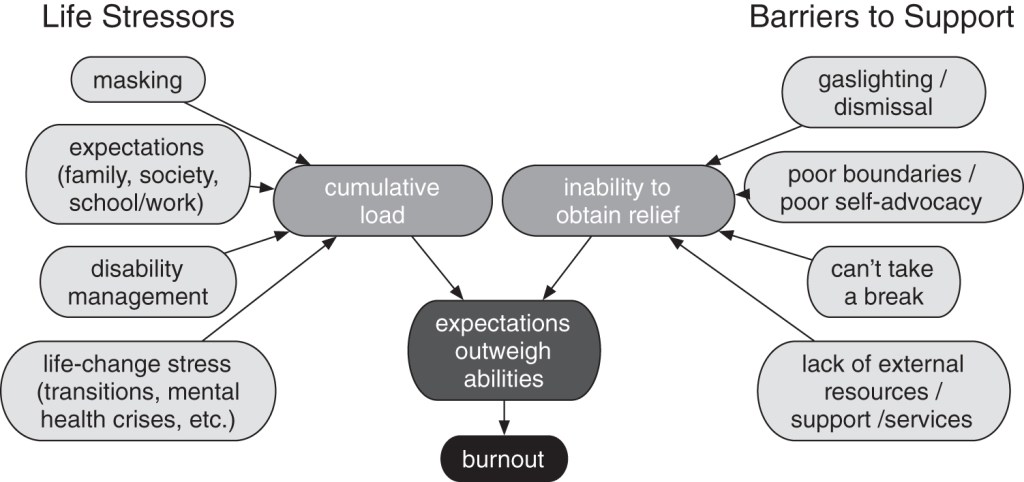
This shows how life stressors and barriers to support combine to create a condition where expectations outweigh abilities. As examples masking, expectations, disability management, and life-change stress increase cognitive load, while gaslighting/dismissal, poor boundaries/self-advocacy, can't take a break, and lack of support create inability to obtain relief. Together these create expectations that outweigh abilities which leads to burnout.
From: Raymaker, D. M., Teo, A. R., Steckler, N. A., Lentz, B., Scharer, M., Delos Santos, A., Kapp, S. K., Hunter, M., Joyce, A., & Nicolaidis, C. (2020). “Having All of Your Internal Resources Exhausted Beyond Measure and Being Left with No Clean-Up Crew”: Defining Autistic Burnout. Autism in Adulthood, 2(2), 132–143. https://doi.org/10.1089/aut.2019.0079
Continue reading “Eating During Evil Times”

Communication Speed Mismatches

Think about what makes something accessible. You probably think of ramps and elevators, and maybe you think of things like sensory needs. What about communication speed? Communication speed can be just as much of a barrier as a set of stairs, particularly for some autistic or neurodivergent folk.

A group of people sitting in a large room in a circle, talking. It looks like some sort of support group.
Photo by Tima Miroshnichenko on Pexels.com
Continue reading “Communication Speed Mismatches”

“Yes, it’ll be accessible!”

When you show up, you’ll probably also hear, “why are you angry?”

“These words “It’ll be accessible” doesn’t mean what it says. If you are disabled, and you hear this phrase, what it really means is, “Our assistant manager knows someone with a disability, and they did just fine at our event/store/business/service/etc.” It certainly doesn’t mean it’ll be accessible.

Photo by Andrea Piacquadio on Pexels.com
Continue reading ““Yes, it’ll be accessible!””